Recently, UK Research and Innovation (UKRI) published a major review on university spinouts and investor engagement. Its conclusion was strikingly simple: the UK no longer has a shortage of ideas, research quality, or even startup creation. Instead, the challenge now is turning innovation into companies that grow, scale and endure during challenging times.
In other words, the problem is not invention. It is what happens next in terms of effective and meaningful translation into practice. Rather than treating innovation as a pipeline, this blog looks at the overlooked space where research, practice and industry learn to make sense of each other — and why that matters more than ever. As the innovation conversation continues to shift, the most valuable question becomes not how ideas transfer, but how they translate.
Connection Isn’t The Problem – Timing Is
For years we have imagined innovation as a journey — a linear pipeline beginning with discovery and ending with a business. But the latest UKRI review hints at something more complicated. The journey from idea to impact is difficult not because universities and industry fail to connect, but because they connect too late or fail to align with wider considerations.
By the time a company exists, many assumptions are already fixed. By the time funding arrives, the shape of the potential technology is already set. And by the time collaboration starts, understanding has already diverged. Innovation struggles not at the moment of invention, but at the moment of interpretation. Which raises a much deeper question:
What kind of environment helps different worlds understand each other early enough?
The gap nobody quite owns
Typically, most innovation ecosystems are built around three familiar spaces:
- the university, where exploration and discovery happens
- the business accelerator, where ventures form
- the investor ecosystem, where companies scale
Between them, however, lies a much less defined territory. Where people are not yet founders. Where research is not yet a product. And where products are not yet fully understood.
This is the stage where a scientist, say, realises the real constraint isn’t chemistry but regulation. Where a founder discovers the market behaves differently in practice than it does in theory. And where students see that knowledge changes meaning when it meets organisations and working practices.
This is the stage where ideas become usable. It is also the longest stage — and the one we have historically treated as a brief transition.
In reality, this is the phase where most innovation risk actually lives — not technical feasibility, but contextual understanding. And crucially, it is the phase that rarely belongs to a single institution.
From transfer to translation
We often talk about knowledge transfer — as though ideas move intact from one environment to another. But anyone who has worked across academia and industry knows this rarely happens. Research questions change once confronted with practical constraints. Engineering problems change once theory becomes available. Products evolve once real users appear. Nothing travels unchanged. Everything adapts and evolves.
Innovation therefore depends less on handover and more on interpretation — repeated encounters through which people gradually learn each other’s languages. And so the challenge, then, is one of proximity. Not occasional meetings, but continual coexistence. A place where mutual learnings and overlapping values emerge.
A different role for place
Buildings designed for innovation are often understood as a physical and defined infrastructure: desks, labs, equipment. But their deeper value is indeed relational, because — most immediately — they are places where businesses feel at home, but also because they can sit on the periphery of multiple worlds: between entrepreneurship, academia, businesses and investors. The connectivity between people and ideas being shared and explored, tested and enhanced through meaningful iterations is powerful and so needed across our society.
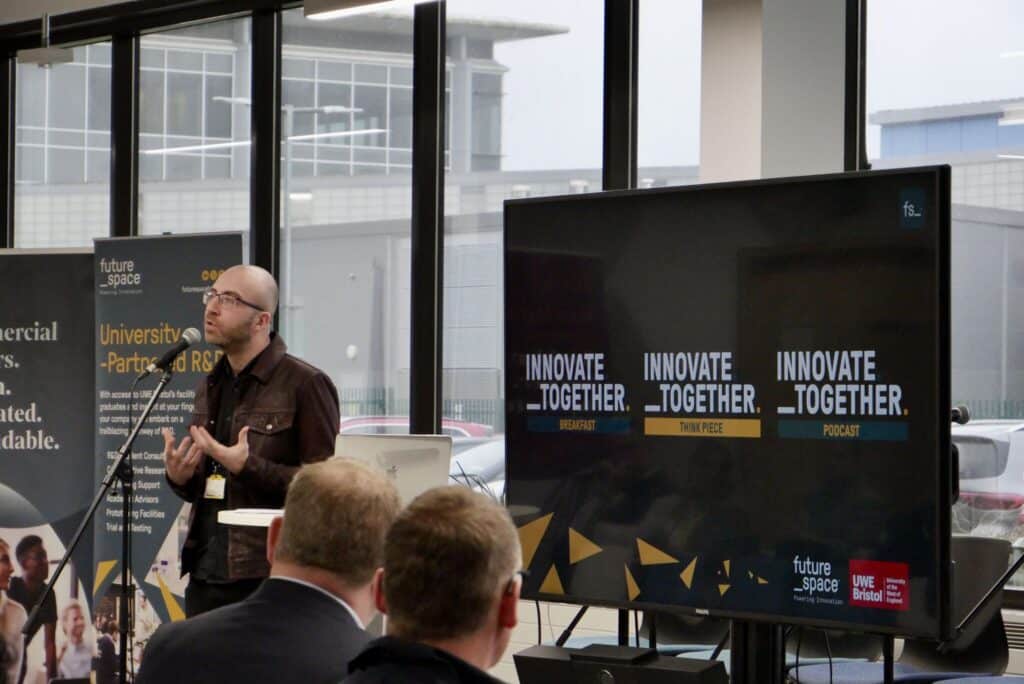
At Future Space, based with the University Enterprise Zone at UWE Bristol, our companies often describe the moment something “clicked” not during a formal programme, but during an unexpected interaction — a conversation with a researcher over coffee in the University Enterprise Zone cafe, an informal student project revealing a new use case, another founder explaining a regulatory barrier they had already encountered but failed to solve.
The value of proximity is that questions get asked earlier and perhaps with a greater level of genuine intention. A design flaw is noticed before manufacturing. A research direction shifts before publication. A product pivots before investment. In other words, innovation becomes less about acceleration through a linear pipeline and more about alignment between multiple commercial, research and design imperatives. And, within that multifaceted model, progress feels smoother because divergence happens less often. In other words, companies don’t just grow faster — they grow with fewer wrong turns or false-starts.
Spin-outs — and spin-ins
Universities have become increasingly effective at generating spin-outs; the UKRI report says as much. But our view is that this logic frames innovation as purely outward movement: knowledge leaving academia as innovation for the enterprise market.
What we see in practice is far more cyclical. Some companies arrive at Future Space already formed, seeking access to research capability. Others begin as collaborative projects and only later realise they are businesses. Students embed in organisations and help to shape product development. Researchers refine questions through exposure to industry reality.
Innovation does not only spin out. It spins in — and this is something worth exploring more, especially in terms of defining new models of quadruple helix universities, their connection with and for industry and the wider social innovation potential with communities.
In fact, Future Space works less like a pipeline stage and more like a permeable innovation membrane — allowing movement in both directions. When working at its best, our businesses inform university research at the same time as that same research informs our businesses.
The boundary softens. The innovation story is like a non-linear Christopher Nolan movie — sometimes it starts at the end, flashes backwards, jumps forwards, shifts perspective multiple times and loops circularly. It’s not quite Interstellar-levels of wormholes and fifth dimensions, but it’s not always that far off, either.
Before the company exists
Here’s a good example: At Future Space, our companies sometimes describe forming almost accidentally — emerging from collaboration rather than starting with a business plan. The use cases emerge from testing the market, from trial and error, and from learning from others. The organisation crystallises around understanding. In effect, the company is not the starting point. It is the consequence. And these questions are often answered not through formal, structured programmes, but through exposure to other people solving adjacent problems.
Trust before investment
Similarly, investment readiness these days is often framed as structured preparation: pitch decks, projections, valuation models, and so on, all told in a linear story. But readiness is also relational. Investors typically build confidence through familiarity with a company, no matter how new — observing how teams think and adapt over time. In shared environments, this happens naturally. Conversations accumulate long before a funding round exists. In other words, companies are not performing readiness — they are demonstrating learning.
The importance of recurrence
Even in a student innovation context, the point still stands: innovation thrives on recurrence, happening not in stages — but in loops. Future Space increasingly behaves like this, too — not a place where students just pass through, but a place they remain connected to. Think about it: students become employees; employees become founders; founders become collaborators; collaborators shape research; research shapes the next generation. It’s the kind of multi-perspectival innovation culture that is often so difficult to track, let alone to tell as a linear story. But our point, at least, is clear: innovation, for all, thrives on recurrence.
A translation layer for policy
Seen this way, environments like Future Space are translation layers between the worlds of innovation and enterprise. They begin to allow different domains — research, talent, industry and investment — to overlap continuously rather than interact at fixed checkpoints. Here, organisations gradually learn each other’s logic. Fewer technologies search for problems. Fewer companies form prematurely. And fewer collaborations begin too late. Companies emerge at the moment they make sense to emerge — if indeed they become companies at all.
And yet, much innovation policy often aims to speed up commercialisation. Which we understand. The UK needs it to happen. But speed without shared understanding creates problems later — redesigns, pivots and misaligned expectations. Translation shortens the distance between discovery and adoption differently. Instead of moving faster, it reduces correction. Innovation and enterprise evolve together in a relationship, bumps and all.
In time, progress becomes steadier — and, over time, with any luck, faster.
Closing thought
So no, innovation fundamentally isn’t a linear process; you can’t pass innovation along a conveyor belt and expect it to build itself step by step. The UK’s research strength is widely recognised. The next challenge, therefore, is not generating ideas, but helping them find their place in the world before they are locked into structures that are difficult to change. When discovery and application coexist, innovation becomes less forced and far more natural.
Of course, we do appreciate the idea of a staged, linear process to spinning out innovation sounds good on paper. It is easily explainable as a beginning-middle-end story to whoever is listening. But perhaps the real story we should be telling, no matter how jumbled the narrative may seem, is that if the UK’s innovation-to-enterprise gap is to close, then we need places that embrace their complex mission as homes for not simply one part of the innovation story — but as translation layers between all parts of that story, between academia, startups and investors, all of which are crucial to making innovation happen now, not later.
The University Enterprise Zone at UWE Bristol, we believe, sits in that gap. Not just helping ideas leave the university — but helping industry enter it. Not just spinning companies out, but spinning them in. And in that space between worlds, innovation becomes less about transfer and more about translation — the condition that allows it to last.