By Marc Griffiths & Matt Freeman
The recent CBI Economics report, Unlocking Growth: The Role of Universities in Powering the UK’s Economy, should be required reading for anyone interested in innovation, productivity and regional growth.
Its findings are striking, though perhaps not for the reasons many would expect. The report confirms something that those working at the intersection of universities and business have known for years: universities are not peripheral to economic growth. They are core infrastructure. Businesses rely on universities for talent, research capability, specialist expertise and innovation support. This is particularly true in high-growth sectors such as advanced manufacturing, digital technologies, life sciences and clean technologies, where universities often provide capabilities that businesses simply cannot replicate internally.
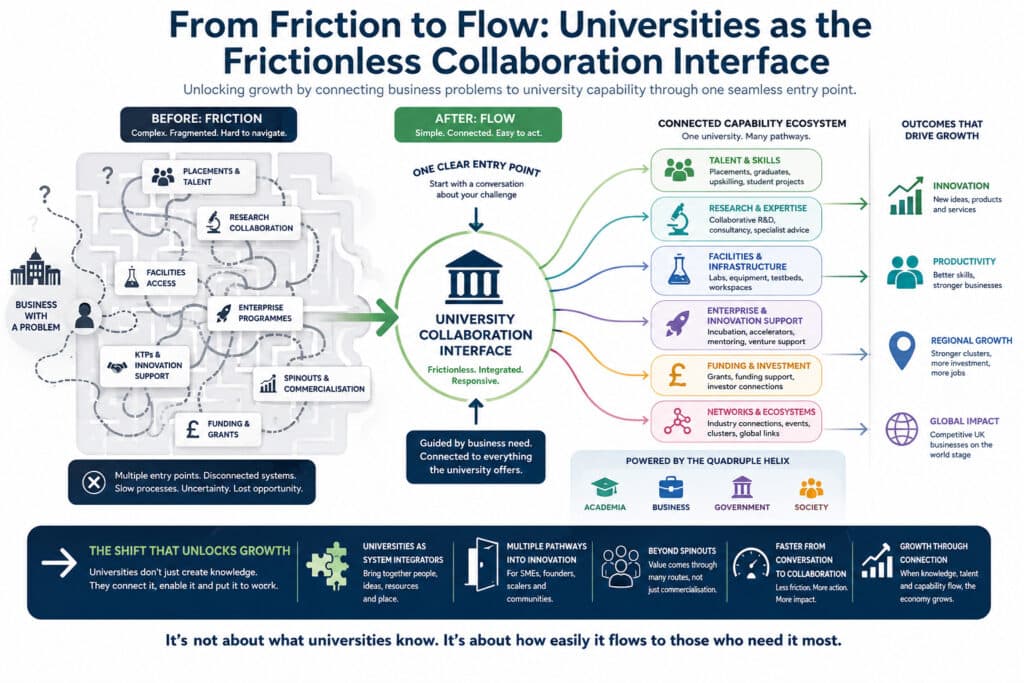
Yet the report also identifies a persistent challenge. The problem is not to do with a lack of innovation, nor a lack of talent. The problem is that collaboration remains too difficult. Businesses continue to report barriers including complexity, fragmented systems, slow processes and uncertainty about where to start. For SMEs in particular, engaging with universities can feel less like accessing a growth partner and more like navigating a maze.
The report reaches an important conclusion: the UK does not need to build entirely new innovation systems. Instead, it needs to unlock and scale what already exists by making those systems easier to access and more responsive to business need. In many ways, this reframes one of the most enduring debates in higher education. For decades, universities have focused heavily on knowledge transfer. Perhaps the next challenge is not knowledge transfer at all.
Perhaps it is interface design.
From Knowledge Transfer to Frictionless Collaboration
Universities have spent years investing in innovation programmes, enterprise initiatives, incubators, accelerators, research centres and commercialisation activities. Collectively, these investments have created extraordinary assets.
The challenge now is that businesses rarely experience universities as integrated systems. Instead, they experience them through multiple disconnected entry points. One department offers placements. Another supports research collaboration. A third manages facilities access. A fourth runs enterprise programmes. A fifth oversees spinouts. Each may work well independently. Yet from a business perspective, engagement can still feel fragmented.
This is where the concept of a “frictionless collaboration interface” becomes particularly powerful. Rather than asking how universities organise themselves internally, it asks a much simpler question:
How easy is it for a business to access everything a university has to offer?
The answer matters because businesses do not wake up wanting a Knowledge Transfer Partnership, an internship or a contract research agreement. They wake up with problems.
They need skills. They need expertise. They need facilities. They need customers.
The institutions that will lead the next phase of university-business collaboration will be those that organise themselves around these needs rather than around their own structures.
Universities as System Integrators
The CBI report repeatedly highlights the importance of universities as anchor institutions within regional economies. This role extends far beyond teaching and research. Universities connect talent to opportunity. They connect ideas to investment. They connect businesses to expertise. They connect entrepreneurs to networks. They connect regions to growth.
Viewed through this lens, universities are becoming less like standalone institutions and more like system integrators. Their role is increasingly to bring together research, innovation, skills, enterprise and place into coherent ecosystems that accelerate growth. This is particularly important as governments increasingly focus on place-based economic development and cluster growth. Innovation rarely emerges from isolated organisations. It emerges from connected ecosystems.
The most successful regions in the world understand this. They create environments where researchers, founders, investors, students, policymakers and businesses interact continuously. Tomorrow’s challenge for UK universities – scrap that, today’s urgent challenge – is not simply to participate in these ecosystems, but to actively orchestrate them.
Beyond Spinouts
One implication of this shift is that universities may need to broaden their definition of innovation success. For much of the past decade, attention has focused heavily on spinouts and research commercialisation. These remain important, but they represent only one pathway through which universities create economic value. The reality is that many innovation-active SMEs will never become spinouts, just as many graduate founders will never emerge from formal commercialisation programmes. Many businesses need access to facilities, talent, expertise and networks rather than intellectual property. If universities focus too narrowly on commercialisation, they risk overlooking a much larger opportunity.
The future may belong to institutions that create multiple pathways into innovation. Pathways for academic founders. Pathways for graduate entrepreneurs. Pathways for established SMEs. Pathways for scaling businesses. Pathways for community innovators. Pathways that recognise innovation is not something done exclusively by researchers, but something that can emerge from collaboration between academia, business, government and society. This reflects the growing influence of the Quadruple Helix model of innovation, which places equal emphasis on these interconnected actors.
What This Looks Like in Practice
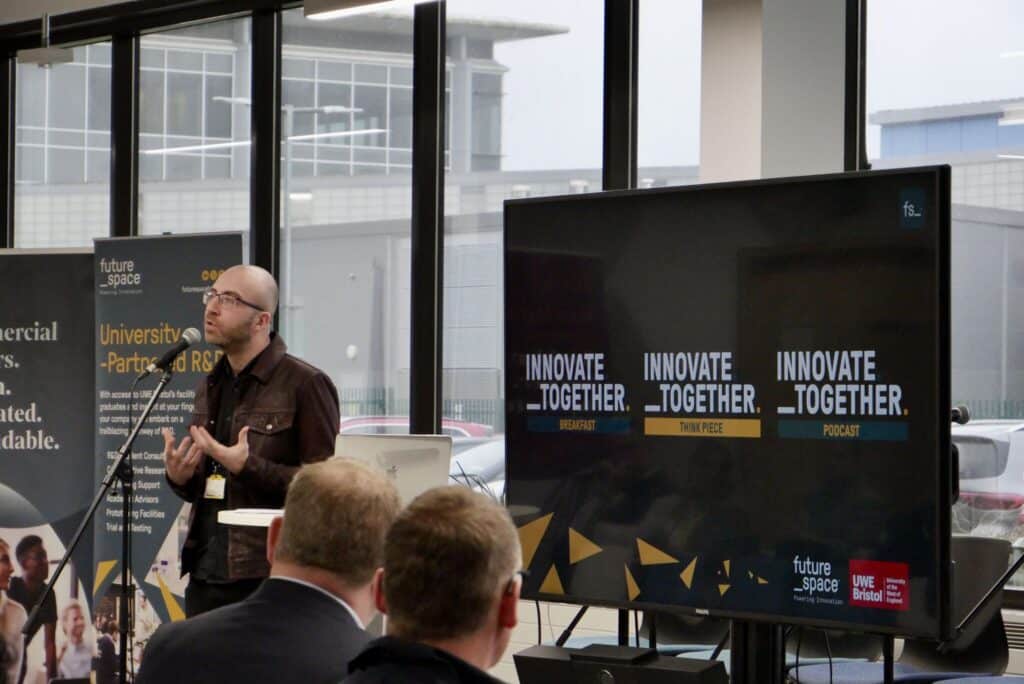
At UWE Bristol, Future Space provides a useful example of how this thinking is beginning to evolve. Over the past decade, Future Space has developed what might be described as a “full-stack” innovation model, integrating workspace, business support, collaborative R&D and talent pipelines within a single environment.
Importantly, the value is not any one component. The value lies in the connections between them. A business may enter through workspace. It may then access student consultancy projects. This may lead to collaborative research. That may unlock funding opportunities.
Those opportunities may create jobs and attract investment. The individual interventions matter. But the ecosystem matters that little bit more.
The lesson is not that every university should build a Future Space. The lesson is that every university should think carefully about its collaboration interface. How visible is it? How connected is it? How easy is it to navigate? How quickly can businesses move from first conversation to meaningful collaboration? These questions may ultimately prove more important than the individual programmes themselves.
The Next Decade
The CBI report offers a timely reminder that the UK already possesses many of the ingredients needed for innovation-led growth. World-class universities. Talented graduates. Exceptional research. Ambitious businesses. Strong regional ecosystems.
The challenge is not creating more ingredients. The challenge is connecting them more effectively. Universities have spent decades becoming centres of knowledge creation. The next decade may require them to become something else as well: The most effective collaboration platforms in the economy.
Put simply, growth increasingly depends not on what universities know, but on how easily that knowledge, talent and capability can flow into the businesses that need it most.